Image Map


Read OW in your inbox!:

Delivered by FeedBurner


Thru-Hiking the Florida Trail How-To
Little Lake Creek Loop, SHNF
Our Work in Print
Thru-Hiker Deliciousness
The Greatest Mountain

Sorry. No data so far.


LINKwithlove


Nature Blog
 Network

  • May 2012
  • April 2012
  • March 2012
  • February 2012
  • January 2012
  • December 2011
  • November 2011
  • October 2011
  • September 2011
  • August 2011
  • July 2011
  • June 2011
  • May 2011
  • April 2011
  • March 2011
  • February 2011
  • January 2011
  • December 2010
  • November 2010
  • October 2010
  • September 2010
  • August 2010
  • July 2010
  • June 2010
  • May 2010
  • April 2010
  • March 2010
  • February 2010
  • January 2010
  • December 2009


  • Archive for the ‘Outdoors’ Category

    fungus4

    fungus3

    fungus2

    fungus1

    It’s been so moist up here that there is a plethora of strange fungi growing. Some are brightly colored, others are just plain large. They definitely add some texture to the forest environment. The top one reminds me of a coral!

    redeft1
    My first encounter with these little newts were on the Appalachian Trail. In the spring they were littering the trail and we’d have to be careful not to step on them. Sometimes you can walk absently and not notice that you were inching too close to the little creatures.

    redeft2
    These newts are in their juvenile terrestrial stage and that can last about two years. Once they reach the adult stage they will move to ponds and wet areas and live their life out there. I have only seen a few out here in PA but they are nice reminders of the AT and the fun wonders of the eastern woods! Sometimes they are relaxed enough to let you pick them up. This one let us pick leaves off of it so we could get a closer photo.

    Last weekend we went to Pedernales Falls State Park for our first camping trip of the season. It was beautiful and while the Pedernales River was not running much (hey, Texas is in a major, major drought!) it was still wonderful. It is only about three hours from our house so even though we set up the tent in the dark it still wasn’t a terrible drive from the Houston area to west of Austin.

    I’m always upset with people who gloss over autumn in areas that may not have major leaf shows like the northeast. Fall happens in different ways in the south and the drought is making it appear more pronounced with the dead trees showing up everywhere.

    14
    The dry rocks across the river. This particular area is most popular but it does not allow swimming.

    13
    A random watermelon or other gourd growing on a sand island. I’m guessing someone left a rind out and up sprouted a plant!

    12
    This cypress shows how deep and fast the river can flow; look at the debris wrapped up in the limbs!

    11
    Sycamores were showing the beauty of Texas autumn.

    10

    9

    8

    7

    6

    5

    4

    3

    2

    1

    I took a lot of videos that I am hoping to put together into a bigger video. Having problems with my movie maker though so it might be a few weeks before I get it up. We did two different hikes, one to Wolf Mountain (think large hill…still kicked my butt though!) and another to a different section of the park across the river. That side had some poorly labeled sections of trail and we spent at least twenty minutes wandering around trying to determine where the trail went.

    I definitely recommend going to this state park. It is beautiful and has a lot of things to see. We had a western scrub jay show up at our campsite, relative of the Florida scrub jay, and a pair of cardinals that were in love with Chris’ truck. I think they liked seeing their reflections in the windows.

    Hopefully more camping excursions will happen this Fall!

    Mentally I was prepared for a 10-12 mile hike. Because our maps were conflicting and not quite accurate we ended up on a 16 mile hike and I could feel it at the end. Hiking as much as we have hiked in the last year and a half it is easy to gauge how far we travel. Sometimes I think that since we are going on a day hike that I don’t need to prepare as if I’m thru-hiking. That’s a mistake! I learned when we hiked to the giant sycamore and wore cotton socks. This time I didn’t wear my hiking underwear…bad idea. Chafing! I wore the right socks but wasn’t in my normal boots so I ended up with some blisters, one that ended up blood filled, something I’d never had before.

    It was an enjoyable hike, though. I’m always bummed when I go places that don’t seem to get much use. We were in some fairly far out regions of the forest and I wonder how often anyone comes through there. A few forest roads access that area so one can get in that way, though.

    We ended up making a large loop out of the North Wilderness Trail and then connecting the west end of the Little Lake Creek Loop, back to the Pole Creek Trail that we’d taken on our last hike. Chris found a better map online and figured it to be about 16 miles. I had guessed 18.

    IMG_0464

    IMG_0465

    IMG_0466
    A small patch of snow-on-the-prairie, Euphorbia bicolor, made me opt for a photo stop. Can you tell sedentary work life is catching up with me? Hrm. More running and yoga needed.

    IMG_0467

    IMG_0469

    IMG_0481

    IMG_0482
    Not too far after this point we heard thunder and Chris thought we might be half way at this point. If we’d been on the right trail and our maps weren’t messed up. Good thing the main storm bypassed us, but we did get a five to ten minute sun shower a little while later.

    IMG_0483

    IMG_0484
    We saw a lot of deer on the trail, plus a pack of three dogs that appeared to know where they were going, and then this little turtle. I think this little friend is a three toed box turtle.

    IMG_0485
    Hi!

    IMG_0487

    IMG_0488
    We were supposed to have been on this trail for most of the time, however the map was labeled wrong. Then we chose to go to the right and took the long route. Had we gone left we’d of done the 10-12 miles we’d estimated originally. Oh well! Adventure!

    IMG_0490
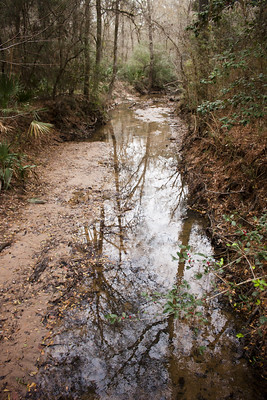
    One of the few water sources we saw.

    IMG_0491
    A luna moth dead on the trail.

    IMG_0492

    IMG_0493
    And another small water source.

    I need to be out doing 16 miles every weekend! Love the feeling after a good hike and being out in the woods. I’m disappointed that there is this huge forest right near a large metropolitan area and it is not used nearly like it should be. Maybe that’s a good thing, I don’t know? But, Ocala National Forest is right by Orlando and Ocala and gets heavy use, Chris says mostly because of the springs, but lots of hiking goes on in that area. Texans are missing out!

    vernonia4

    vernonia3

    vernonia2

    While we were doing our field work in the Big Thicket this late spring and early summer we kept coming across this plant in its pre-blooming stage. No one could figure it out until finally it was identified by Ron Lance. And not much later the plant started blooming and it was beautiful! The tell-tale white stripe in the leaves helped us identify it later on without blooms.

    This particular plant was photographed at Tandy Hills. I was relieved to see a plant I knew among the many unknown prairie plants that abound the preserve. There were a couple of bugs we tried to photograph that were hanging out on the purple inflorescence but I didn’t get any spectacular shots.

    More info:
    +Illinois Wildflowers
    +Wildflower.org
    +USDA plant database
    +Seeds from Prairie Moon—can’t verify the company since I’ve never ordered from them, but if you are looking for your garden, here’s an option.
    +Houston Audubon

    bluebell2

    bluebell4

    bluebell5

    bluebell7

    bluebell6

    bluebell3

    bluebell

    This annual Texas native is not very common, though we did see the ones shown above at Tandy Hills. The subtle blue-purple flower deserves more respect than it gets, being out shown by other grand Texas natives like the bluebonnet. You may know this genus as also Lisianthus, which can be found at garden centers. Wildflower.org suggests their rarity is due to their beautiful stature and having been picked too much that they cannot reseed. In the gardening world there are many varieties and cultivars, so you’ll be able to find some variety.

    More information:
    +A really good write up on the Eustoma genus and the differences regarding the species.
    +Info on propagation from seed
    +Wildflower.org information.

    camrad5

    camrad4

    camrad3

    camrad2

    camrad1

    This beautiful vine can sometimes be mistaken for Bignonia capreoleta, or cross vine. While the similar red flowers might fool you, taking a look at the leaves will change the story as the trumpet creeper vine has pinnately compound leaves.

    While this is a native plant, it is also quite weedy and can be invasive. If you are looking for a space to be completely covered in vines, then I would recommend this plant. If not, you might just leave it for the woods and natural space instead. As a hummingbird attractor, this is one great plant since the red tubular flowers offer the perfect sipping device for the birds to get nectar from. If looking to start from seed, the pods are readily available in the late summer and early fall to collect and start a plant from seed.

    More information:
    +Floridata
    +USDA
    +Hummingbird information
    +Wildflower.org

    rabbit4
    A couple of evenings ago we were walking my brother, niece and sister in law to their car after dinner. I was heading back inside when I noticed something dark in the grass. Thinking it was a mud clump or, well, I really don’t know what else, I went to check it out.

    rabbit3
    Chilling in the shade, even though it was still 100* after 7pm, was this little rabbit.

    rabbit2
    And it was little. My hand here for comparison.

    rabbit1
    A few inches away was a dead bug being feasted on by ants and subsequently some ants were visiting this little rabbit. I got fairly close to the poor thing but it wouldn’t move. Mom ran the hose to flood away the ants and to cool the rabbit down a little, and I eventually kicked the bug away so the bunny wouldn’t be overrun with ants.

    We came out a few more times that evening but by the next morning it had hopped away. Good luck little fella!

    I love when wildlife shows up in the suburbs. We certainly didn’t have this growing up—finally the neighborhood has aged enough that wildlife has returned. My friend Sara even wrote an ode to a dead coyote.

    In case you missed it: Part 1 & Part 2.

    Wrapping up our tour of the Watson Preserve a few months later…

    chris
    We begin the final part of the tour through the pitcher plant bog that was actually quite dry.

    field3

    field2

    pink
    A bud of the Calopogon tuberosus orchid.

    plant

    field
    Love the orchids intermingled with the pitcher plants in this one.

    sarracenia
    Pitcher plants certainly have their own personality.

    colicroot
    Love the unassuming yellow colicroot, Aletris lutea.

    flowers
    And the beautiful pitcher plant flowers…

    greenlynx
    I also love finding the green lynx spiders tucked under and between leaves. They can be finicky to photograph that’s for sure!

    yellowflower

    trail

    me
    I really should stop and take photos of myself more often. I try to snap one of Chris whenever we are out but rarely do I get one of myself. A few years ago I did self portraits for awhile and they were fun but I was definitely self-conscious.

    erythrina
    Erythrina herbacea, coralbean leaves.

    path2

    path

    house
    Geraldine Watson’s beautiful home nestled into a sand hill near the pond.

    milkweed
    More beautiful milkweed on this property.

    ferns

    If you are ever in the boonies of east Texas definitely drop by this beautiful property and check it out!

    Let me tell you something. This post was a booger to put together. Why? Because I did a lot of research. Why? Because I don’t know everything—duh!

    First, a brief explanation of the Local Adventures title. While some aspects of it might be similar to Nature in the City posts they will differ in that they aren’t going to be strictly nature or in the city. NITC posts focus a bit more on parks/areas that are within an urban environment and they may or may not have a playground. (Now I am reminded I need to do some NITC posts again soon.) Local Adventures will focus on anything from a hike within a natural area nearby or a few hours from wherever I live (still transient at the moment) to canoeing and kayaking or maybe rock climbing…basically anything adventurous. So, really it is a bit of a work in progress as I develop the series and roll with it.

    Now I bring you the first in the series. I will eventually cover more of the trails at the FWNC so stay tuned!

    Location: Fort Worth Nature Center
    Trail: Cross Timbers Trail, 3.37 miles round trip
    Activities: Hiking, trail running, photography, nature/wildlife viewing
    Bring Water and a snack!

    The trail begins from a parking area near the West Fork of the Trinity River and crosses a levee that is adjacent to a channel to the east as you walk over the river. The river is dammed up and channelized through several lakes in this area.

    marsh
    This is the area to the west of the levee that is marked on the map as the lotus marsh. Didn’t see any lotus, though.

    path
    Once down the levee the main trail begins and you can choose which way to go as the path is a circle and will bring you back to this point.

    logs

    chris
    On the Florida Trail it became a running joke that when we saw a bench Chris would have to sit on it. Since the FT is not as developed as the AT, where shelters and benches are common, we usually made do with stumps or the ground. So, Chris got his bench on this little trail.

    path2
    It was a cloudy morning the day we went out so the woods appeared dark and mysterious. Some of the growth on the trees reminded me of the epiphytes covering the trees in Florida.

    adrift
    On the surface it might not appear that a lot is going on but one has to look close to see the smaller bits of excitement and beauty.

    veg
    Watch out, the nettles will bite!

    vitis

    grape
    Chris tried one of the grapes back at the parking lot and informed me that it was pretty sour! Sounds like it would be good for jams or wine!

    unknowns
    What took me the most time for this post was researching the plants and identifying them. Don Young with Tandy Hills sent me a plant list for TH and the FWNC so I utilized that heavily. If I can narrow something down to a genus or family and go from there I will, and then it is all about my friend Google. But if I don’t know where to start then I throw them out there for the world to try to identify—-so if you can help me out, lemme know! Edited 7/24/11: Someone at FW Nature Center has told me the shrub is a privet while the yellow is of the primrose family, possibly Oenothera rhombipetala. Thanks Suzanne!

    trail

    skull
    Sometimes fauna is harder to come by than flora but we managed to find this skull. I poked around on the internet looking at a few skulls I thought it might be and I have a friend in Florida taking a look at it, too, but my first guess is that this is a coyote skull. I’m basing the guess on the shape of the nose. I initially was going with opossum or bobcat but I don’t think those are right. If someone else is good with skulls by all means help me out! Several people have said this is a raccoon, I’m still on the fence on this—stubborn—will have to look at the whole skull again soon.

    field
    Perhaps almost half way through the trail opens into this beautiful field allowing for more diversity in blooms.

    gaillardia
    I was very familiar with Gaillardia pulchella aka: Indian blanket so I knew this was probably in the same genus—and whaddya know…I was right!

    vines

    wildlife
    Looking for wildlife is not necessarily about seeing a large mammal, though that is certainly nice, but looking for the smaller signs.

    oak
    Since the photos are a bit cropped here I’m not certain on the oak species but if I were to guess I’d say the left photo is a blackjack oak (Quercus marilandica) and the right photo is a post oak (Quercus stellata). And the insect gall—oh I did some Googling but I wasn’t positive on anything so I decided not to guess. And if you are curious about galls…all types of galls! and the site I was using for identification.

    lichen
    Lichen! Again, not the best with identification of that sort of thing, but wanting to learn!

    path3
    I think these two photos are my favorite from the entire walk. This is from the northern part of the loop and the lighting at this time was beautiful. It was so picturesque and made me think of the photos you see that you always wish you could be in—well, I was in one of those!

    creek
    Back on the levee to the car…this is the channel we followed.

    spiny

    creepervines

    sycamore
    A beautiful sycamore, Platanus occidentalis, definitely not as large as the one from Sabine NF.

    sunflower
    And finally, back near the car, sunflowers dotting the sides of the levee.

    Related Posts Plugin for WordPress, Blogger...